A minimalist website looks effortless when the typography works. But behind that clean, quiet feeling is a real design decision choosing the right heading font pairing. Get it wrong, and the whole page feels off. The headings either shout too loud or disappear into the background. This guide helps you avoid that problem by showing you exactly how to pair heading fonts for minimalist websites, with practical examples you can use right away.
What does minimalist font pairing actually mean?
Minimalist font pairing is the practice of combining two typefaces or two weights of the same typeface in a way that creates visual contrast without adding visual noise. On a minimalist website, there is nowhere to hide bad typography. No heavy graphics, no busy backgrounds. The fonts are the design.
A good minimalist heading font pairing does three things:
- Creates a clear hierarchy so visitors know what to read first.
- Matches the brand's tone without drawing attention to itself.
- Stays readable across screen sizes and devices.
The goal is not to be boring. It is to be intentional. Every font choice should feel deliberate, even if the overall look feels simple.
Why does font pairing matter more on minimalist websites?
On a content-heavy or visually rich website, a mediocre font choice gets buried under images, colors, and layout tricks. On a minimalist site, typography carries almost the entire weight of the design. A heading that clashes with the body text, or a display font that looks gimmicky beside a clean sans-serif, becomes the first thing people notice and not in a good way.
Minimalist design also tends to use more whitespace and larger type scales. This means headings are bigger and more prominent. The font you pick for those headings sets the emotional tone of the entire page. Pair Raleway with Lato, and the page feels light and modern. Pair a heavy slab serif with a thin sans-serif, and the contrast feels dramatic. Neither is wrong but one might fit your project better than the other.
If you are working on a site with a specific visual style in mind, our font pairings by website style resource covers how different aesthetics change the pairing decision.
Which font categories work best for minimalist headings?
Not every font family belongs on a minimalist site. Some typefaces carry too much ornament or too strong a personality. Here are the categories that consistently work:
Geometric sans-serifs
Fonts like Montserrat, Poppins, and Futura have clean, uniform letterforms. They feel balanced and structured. Geometric sans-serifs are a strong default for minimalist heading text because they do not compete with other elements on the page.
Humanist sans-serifs
Open Sans and Inter fall into this category. They have slightly more variation in stroke width, which gives them a warmer, more approachable feel. Good for brands that want minimalism without coldness.
Light-weight serifs
A serif in a light weight can look surprisingly minimalist. Think of thin, elegant serifs used on architecture or fashion portfolio sites. They add a subtle editorial quality without overwhelming the layout. These pair well with a neutral sans-serif for body copy.
Monospace fonts (used sparingly)
Monospace typefaces like Space Mono can work as accent headings on developer portfolios or tech-forward brands. They should not dominate the page, but used for short headings or labels, they add texture without clutter.
What are the best minimalist heading and body text combinations?
The most reliable minimalist pairings follow one of two approaches:
Same family, different weights. Use a bold or semi-bold weight for headings and a regular weight for body text within the same typeface. For example, Helvetica Neue Bold for headings and Helvetica Neue Regular for paragraphs. This is the safest route. It guarantees visual harmony and requires no second font to load.
Different families, shared proportions. Combine a sans-serif heading font with a complementary sans-serif or light serif for body text. The key is that both fonts should have similar x-heights and letter spacing. A common pairing: Poppins Semi-Bold headings with Lato Regular body text. Both are clean, modern, and balanced.
A third option is using a serif heading with a sans-serif body. This works well on editorial-style minimalist sites. For more specific examples across different site types, see our serif and sans-serif heading pairings for e-commerce sites guide.
How many fonts should a minimalist website use?
Two. Maybe one.
A single font family with multiple weights (light, regular, semi-bold, bold) is often enough for an entire minimalist site. This removes the risk of mismatch and reduces page load time because you only load one typeface.
If you do use two families, limit yourself to one for headings and one for body text. Adding a third font almost always makes a minimalist layout feel busy or inconsistent.
What mistakes should you avoid when pairing minimalist heading fonts?
Choosing fonts that are too similar. If your heading font and body font look nearly identical but just slightly different, the result feels like a mistake rather than a design choice. You need enough contrast to create a clear hierarchy but not so much that the fonts clash.
Ignoring loading speed. Each font family adds weight to your page. On a minimalist site, where performance and simplicity go hand in hand, loading four or five font files defeats the purpose. Stick to one or two families and use system font stacks as fallbacks.
Overusing decorative or display fonts. A script font or an ultra-thin display face might look stunning in a mockup, but it often fails at small sizes, on mobile screens, or with longer heading text. Minimalist headings need to be legible above all else.
Skipping font testing on real content. A font pairing that looks great with "About Us" might fall apart when you write a 60-character heading. Always test your pairing with realistic content lengths before committing.
Forgetting about mobile. Headings that feel balanced on a 1440px desktop screen can look cramped or oversized on a phone. Check your heading fonts at every breakpoint.
How do you actually test and choose the right pairing?
Here is a practical process that works:
- Start with the heading font. Pick a typeface that matches your brand personality. Browse Google Fonts, Adobe Fonts, or a foundry catalog and shortlist three to five options.
- Narrow by legibility. Type out a few realistic headings your actual page titles, not "Lorem ipsum." Remove any font that feels hard to read at large sizes.
- Pair with a body font. For each surviving heading font, test two or three body text options. Look for contrast in structure (geometric heading + humanist body, or sans heading + serif body) but similarity in mood.
- Check the scale. Set your heading at 2.5rem to 4rem and your body at 1rem to 1.125rem. Does the hierarchy feel natural? Does one font overpower the other?
- Preview on a real layout. Drop the pairing into a wireframe or a staging page. Look at it on desktop, tablet, and phone. Live with it for a day before finalizing.
Do minimalist font pairings change based on the type of website?
They do. A minimalist portfolio site can get away with a bolder heading choice something with more character because the content is visual and personal. A minimalist SaaS landing page usually needs a more neutral, professional heading font because the text itself is the main content.
E-commerce sites that use minimalist design often benefit from a serif heading paired with a clean sans-serif body, which adds a premium feel without adding visual clutter. Our minimalist heading font pairing guide explores these distinctions in more detail with specific examples by category.
Quick checklist before you finalize your heading font pairing
- ✅ The heading font is clearly distinct from the body font in weight, style, or family.
- ✅ Both fonts are legible at their intended sizes on desktop and mobile.
- ✅ You are loading no more than two font families (ideally one) for performance.
- ✅ You tested the pairing with real heading text, not placeholder copy.
- ✅ The overall mood of both fonts aligns with your brand not just "looks nice."
- ✅ Your fallback stack includes at least one system font that approximates your chosen type.
- ✅ You reviewed the pairing on at least three screen sizes before going live.
Start by picking your heading font first. Get that right, and the body font choice becomes much easier. If you are unsure, a single-font-family approach with two or three weights is always a clean, reliable foundation for a minimalist site.
 Font Pairings for Website Headings by Style Guide
 Elegant Font Pairings for Luxury Brand Website Headings
 The Best Font Pairings for Modern Website Headings
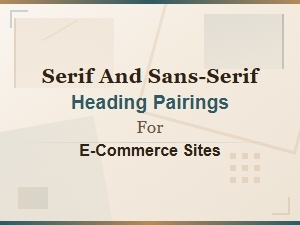 E-Commerce Font Pairings: Serif and Sans-Serif Heading Combinations That Drive Sales
 Best Serif and Sans-Serif Font Pairings for Web
 Serif and Sans-Serif Heading Font Pairings for E-Commerce Websites